Cryptosporidium: Lifecycle, Symptoms, and Treatments
Last reviewed: 2026-03-18
Medical Disclaimer
This content is for informational purposes only and does not constitute medical advice. Consult a qualified healthcare provider before starting any treatment, supplement, or cleanse program. If you suspect a parasitic infection, seek professional medical diagnosis.
What Is Cryptosporidium?
Cryptosporidium is a genus of apicomplexan protozoan parasites that infect the epithelial cells of the gastrointestinal and respiratory tracts in vertebrates. The disease it causes — cryptosporidiosis — is characterized by profuse watery diarrhea and is a leading cause of waterborne illness worldwide.
Over 40 species of Cryptosporidium have been described, but two species account for the majority of human disease. Cryptosporidium hominis (previously C. parvum genotype 1) infects almost exclusively humans. Cryptosporidium parvum (genotype 2) is zoonotic, infecting both humans and animals — particularly cattle, which serve as a major reservoir.
The Global Enteric Multicenter Study (GEMS) identified Cryptosporidium as one of the top four pathogens causing moderate-to-severe diarrhea in children under 5 in developing countries. In the US, the CDC receives reports of approximately 7,500–9,000 cryptosporidiosis cases annually, though actual incidence is estimated to be significantly higher due to underreporting.
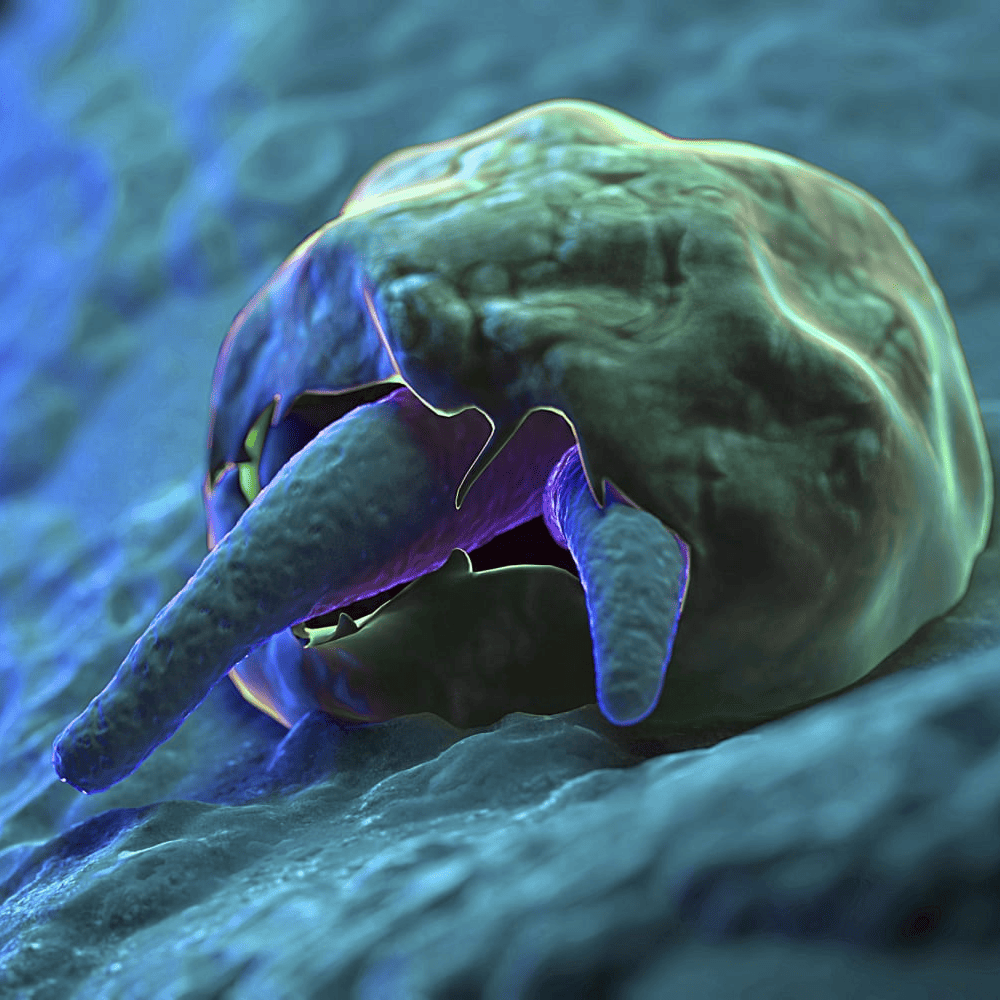
Appearance. Cryptosporidium oocysts are tiny — 4–6 micrometers in diameter, roughly one-tenth the width of a human hair. They are spherical, thick-walled, and contain four sporozoites. Their small size allows them to pass through many standard water filtration systems. Under acid-fast staining (modified Ziehl-Neelsen), oocysts appear as bright pink to red spheres against a blue-green background.
Lifecycle
Cryptosporidium completes its entire lifecycle within a single host, involving both asexual and sexual reproduction.
Stage 1 — Oocyst ingestion. Infection starts when a person swallows oocysts from contaminated water, food, or surfaces. The infectious dose is remarkably low — as few as 10 oocysts can establish infection in a healthy adult, according to volunteer studies.
Stage 2 — Excystation. In the small intestine, exposure to bile salts and enzymes triggers the oocyst to release four motile sporozoites.

Stage 3 — Cell invasion. Sporozoites attach to the brush border of intestinal epithelial cells and become enveloped in a parasitophorous vacuole. Uniquely, Cryptosporidium is intracellular but extracytoplasmic — it sits inside the cell membrane but outside the cytoplasm.
Stage 4 — Asexual reproduction (merogony). The parasite undergoes two rounds of asexual multiplication (Type I and Type II meronts), producing merozoites that invade adjacent epithelial cells and amplify the infection.
Stage 5 — Sexual reproduction (gametogony). Some Type II merozoites develop into male microgamonts and female macrogamonts. Fertilization produces a zygote.
Stage 6 — Oocyst formation. The zygote develops into an oocyst. About 80% of oocysts are thick-walled and are excreted in feces, remaining infectious in the environment for months. The remaining 20% are thin-walled and rupture within the intestine, causing auto-infection — which explains why even a small initial inoculum can produce severe disease.
Stage 7 — Environmental persistence. Thick-walled oocysts are immediately infectious when passed in stool. They are resistant to chlorine disinfection at concentrations used in standard municipal water treatment (up to 80 ppm). They can survive in cool, moist environments for 2–6 months.
How You Get Infected
Cryptosporidiosis spreads through the fecal-oral route. The parasite's environmental resilience and low infectious dose make it highly transmissible.
- Contaminated water. The most common route. This includes drinking water, recreational water (swimming pools, splash pads, water parks, lakes), and ice made from contaminated sources. The 1993 Milwaukee outbreak — the largest documented waterborne disease outbreak in US history — infected an estimated 403,000 people through the municipal water supply.
- Person-to-person. Common in daycare settings, among household contacts of infected individuals, and among men who have sex with men.
- Foodborne. Contaminated raw produce, unpasteurized milk, and unpasteurized apple cider have caused outbreaks.
- Animal contact. Direct contact with infected calves, lambs, or other livestock. Petting zoos are a recognized source of outbreaks.
- Fomites. Contaminated surfaces, diaper-changing tables, and shared objects.
Risk factors include: young age (children 1–5 years), immunosuppression (particularly HIV/AIDS with CD4 count below 200 cells/μL), contact with infected persons or animals, recreational water use, travel to regions with poor sanitation, and working in childcare or livestock farming.
Symptoms
Symptoms typically appear 2–10 days after exposure (median 7 days). The clinical presentation varies widely based on immune status.

In immunocompetent individuals:
- Watery diarrhea — the hallmark symptom. Stools are profuse, non-bloody, and may reach 3–6 liters per day in severe cases. Diarrhea typically lasts 1–2 weeks but can persist for up to 4 weeks.
- Abdominal cramping and pain, often periumbilical
- Nausea and vomiting (more common in children)
- Low-grade fever (present in about 30–50% of cases)
- Loss of appetite and weight loss
- Malaise and fatigue
- Dehydration — the most dangerous acute complication, especially in young children and the elderly

In immunocompromised individuals (especially HIV/AIDS with CD4 < 200):
- Chronic, unrelenting watery diarrhea lasting weeks to months
- Severe malabsorption and wasting
- Biliary tract involvement — sclerosing cholangitis, acalculous cholecystitis, pancreatitis
- Respiratory cryptosporidiosis — chronic cough, hoarseness (rare)
- Potentially fatal dehydration and malnutrition without intervention
In children under 5 in developing countries: Cryptosporidiosis is associated with growth faltering, cognitive impairment, and increased mortality. The GEMS study found it to be a significant cause of death in young children with diarrheal disease.
Asymptomatic infection occurs in an estimated 30% of exposed individuals, though these persons may still shed oocysts and transmit the parasite.
Diagnosis
Standard stool culture does not detect Cryptosporidium. Specific testing must be requested.
Modified acid-fast staining. A stool sample is stained and examined under microscopy. Oocysts appear as round, 4–6 μm pink-red bodies. Sensitivity ranges from 70–80% with a single specimen; testing three separate samples increases sensitivity to over 95%.
Direct fluorescent antibody (DFA) test. Uses fluorescently labeled antibodies to detect oocysts. Considered the gold standard for microscopic diagnosis — sensitivity and specificity both exceed 99%.
Enzyme immunoassay (EIA) / antigen detection. Detects Cryptosporidium-specific antigens in stool. Widely available, rapid (results in hours), and suitable for screening.
PCR (molecular testing). The most sensitive method and the only one that can distinguish between C. hominis, C. parvum, and other species. Primarily used in reference laboratories and outbreak investigations.
Multiplex GI panels. Several commercial multiplex PCR panels (e.g., BioFire FilmArray GI Panel) include Cryptosporidium and can return results within 1–2 hours.
What to tell your doctor: Mention recent recreational water exposure (especially pools and water parks), contact with animals or young livestock, travel history, daycare attendance, and immune status. Note that Cryptosporidium requires specific testing — it will not be detected on a routine ova and parasite (O&P) exam unless acid-fast staining is specifically performed.
Treatment

For immunocompetent individuals:
- Nitazoxanide (Alinia) — the only FDA-approved treatment for cryptosporidiosis. Dosing: adults and children ≥12 years receive 500 mg orally twice daily for 3 days; children 1–3 years receive 100 mg twice daily; children 4–11 years receive 200 mg twice daily. Clinical trials show nitazoxanide reduces diarrhea duration by approximately 2–3 days in immunocompetent patients.
- Fluid and electrolyte replacement — oral rehydration salts (ORS) for mild-moderate dehydration; intravenous fluids for severe dehydration. This is the most important aspect of treatment for all patients.
- Antimotility agents — loperamide (Imodium) can provide symptomatic relief of diarrhea in adults. Not recommended for children under 2.
For immunocompromised individuals (especially HIV/AIDS):
- Immune reconstitution is the most effective intervention. In HIV patients, initiating or optimizing antiretroviral therapy (ART) to raise the CD4 count above 100 cells/μL often leads to spontaneous clearance of Cryptosporidium.
- Nitazoxanide has inconsistent efficacy in severely immunocompromised patients.
- Supportive care — aggressive fluid replacement, nutritional supplementation, and management of biliary complications are necessary.
- No other drug has demonstrated reliable efficacy against Cryptosporidium in immunocompromised hosts, despite extensive research.
For transplant recipients: Reduction of immunosuppressive medications, when safely possible, combined with nitazoxanide and supportive care.

Natural adjunct therapies. Evidence is limited, and no natural remedy has demonstrated clinical efficacy against Cryptosporidium in human trials. Some agents with in vitro or animal-model activity include:
- Garlic (allicin) — has shown antiprotozoal activity in laboratory studies.
- Probiotics — Saccharomyces boulardii and Lactobacillus species may help reduce diarrhea duration and support gut recovery, based on small studies.
- Curcumin (turmeric) — demonstrated anti-Cryptosporidium activity in animal models, though human data are absent.
- Bovine colostrum — contains anti-Cryptosporidium antibodies. A few small studies in HIV patients suggested modest benefit, but results are not definitive.
Natural remedies should be considered supportive only. They do not replace medical treatment, particularly in immunocompromised patients.
Prevention
Preventing cryptosporidiosis centers on water safety, hygiene, and awareness of transmission routes.
- Do not swallow recreational water. Pools, water parks, splash pads, lakes, and rivers may contain oocysts. Chlorine does not kill Cryptosporidium at standard concentrations.
- Use appropriate water treatment. For drinking water, boiling (rolling boil for 1 minute) is effective. Filters labeled "NSF 53" or "NSF 58" with an absolute pore size of 1 micron or smaller remove Cryptosporidium. UV disinfection is also effective.
- Practice hand hygiene. Wash hands with soap and water (not just hand sanitizer — alcohol-based sanitizers do not kill Cryptosporidium oocysts) after using the bathroom, changing diapers, handling animals, and before eating.
- Do not swim when ill. Anyone with diarrhea should stay out of recreational water. After cryptosporidiosis resolves, wait at least 2 weeks before returning to shared water, as oocyst shedding continues.
- Avoid unpasteurized products. Raw milk, unpasteurized cider, and unwashed produce carry risk.
- Practice caution with animals. Wash hands after contact with livestock, especially calves. Supervise children at petting zoos.
- In institutional settings (daycare, group homes): enforce strict diaper-changing protocols, handwashing, and exclusion of symptomatic children.
Prognosis
In healthy individuals, cryptosporidiosis is self-limiting. Diarrhea typically resolves within 1–3 weeks. Some patients experience a relapsing-remitting pattern where symptoms improve and then recur before final resolution.
Post-infectious irritable bowel syndrome (IBS) has been reported following cryptosporidiosis, with symptoms (cramping, altered bowel habits) persisting for weeks to months after the infection clears.
In immunocompromised patients — particularly those with untreated HIV and CD4 counts below 50 cells/μL — cryptosporidiosis can be chronic, debilitating, and fatal. Mortality in this population, prior to effective ART, was significant. With ART and immune reconstitution, outcomes have improved dramatically.
In children in low-income settings, repeated Cryptosporidium infections contribute to environmental enteropathy, growth stunting, and impaired cognitive development.
When to See a Doctor
Seek medical attention if:
- Watery diarrhea lasts more than 3 days
- You show signs of dehydration — dry mouth, decreased urine output, dizziness, rapid heartbeat, sunken eyes in a child
- Diarrhea occurs in a child under 5, an elderly person, or anyone with a weakened immune system
- You develop fever above 38.5°C (101.3°F) alongside diarrhea
- You have HIV/AIDS, are on immunosuppressive medications, or are a transplant recipient and develop any diarrheal illness
Seek immediate medical care if there is severe dehydration (inability to keep fluids down, confusion, fainting), bloody stool, or if an immunocompromised individual develops worsening diarrhea despite treatment.
This article is for informational purposes only and does not constitute medical advice. Always consult a qualified healthcare provider for diagnosis and treatment of parasitic infections.
For more information on symptoms related to Cryptosporidium infections, visit our Parasites & Symptoms page. For treatment options, explore our Anti-Parasitic Solutions page.
References
Get the Free 30-Day Parasite Cleanse Plan
Evidence-based protocols, supplement schedules, and dietary guidance delivered to your inbox.